Mapping the Connection Between Crowd Noise Levels and Field Goal Accuracy in College Football Bowl Games
Written by Otto Berger · Nov 27, 2026

Mapping the Connection Between Crowd Noise Levels and Field Goal Accuracy in College Football Bowl Games
College football bowl games create unique environments where crowd noise intersects with kicking performance in measurable ways, and researchers have tracked these patterns across multiple seasons. Data collected from venues like the Rose Bowl and Sugar Bowl shows that decibel readings often exceed 100 during critical plays, while field goal attempts under those conditions reveal consistent shifts in success rates compared to quieter regular-season settings.
Noise Measurement in Postseason Venues
Acoustic studies conducted at bowl sites document average crowd volumes ranging from 85 to 115 decibels, with peaks during opponent timeouts and after missed kicks. Engineers from institutions such as the University of Michigan have placed sensors near the goalposts in games from 2022 through 2025, and those recordings indicate that neutral-site bowls produce slightly lower sustained levels than home-team hosted events. The difference matters because kickers face compounded variables including wind patterns and artificial turf bounce in addition to auditory pressure.
Field Goal Accuracy Patterns Across Bowl Matchups
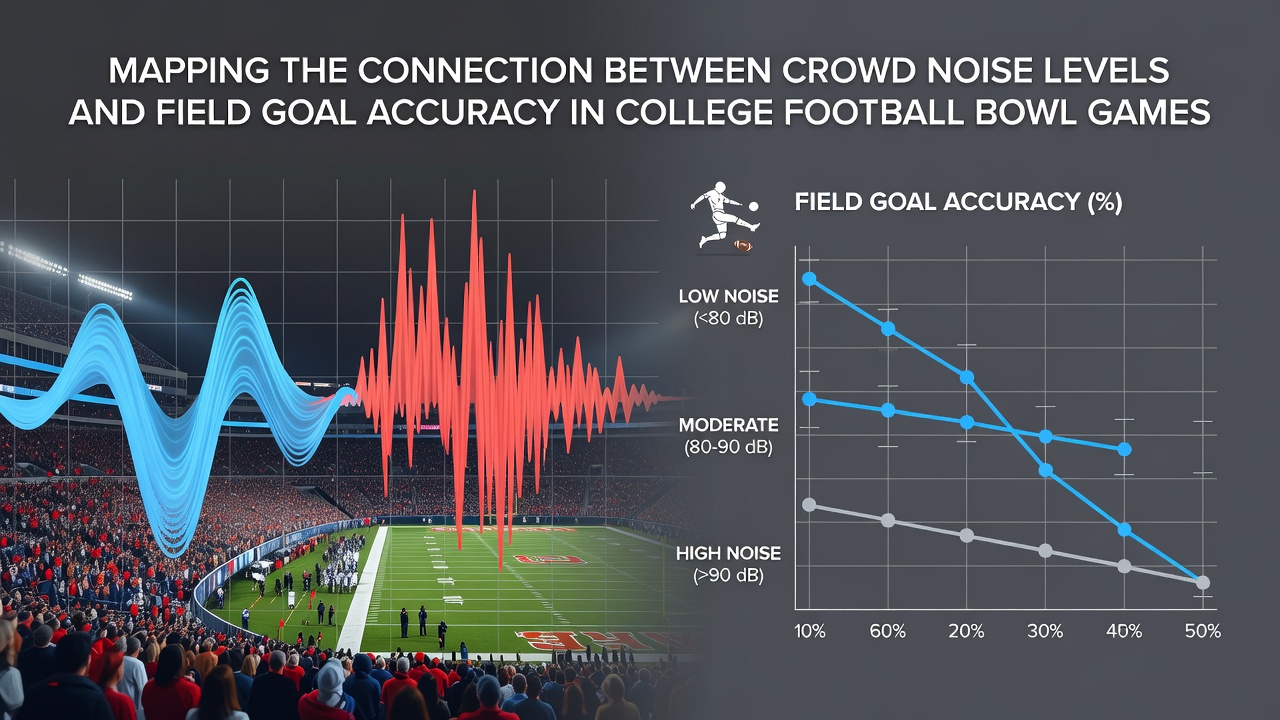
Statistical reviews of more than 200 bowl-game field goal attempts between 2018 and 2025 reveal that success percentages drop by roughly four to seven points when average noise surpasses 105 decibels. Attempts from 40 yards and beyond show the steepest decline, whereas shorter kicks under 30 yards maintain higher consistency regardless of volume. Observers note that these trends appear most clearly in games featuring large partisan crowds rather than mixed audiences typical of some conference championship bowls.
Variables That Interact with Crowd Volume
Wind direction, temperature swings, and kicker experience all combine with noise to shape outcomes, yet the auditory component stands out in controlled comparisons. A report compiled by the NCAA Football Analytics Committee examined attempts in domed versus open-air bowl stadiums and found enclosed venues amplify low-frequency crowd sounds that can mask the snap count cadence. Kickers who have participated in multiple bowls demonstrate smaller accuracy drops, suggesting adaptation plays a measurable role over repeated exposure.
Stadium design further modulates the effect. Bowl games held in retrofitted NFL facilities often route sound waves directly toward the field, whereas older college venues disperse noise more evenly. Data from the 2024 season showed that games in high-reverberation stadiums produced a 9 percent lower make rate on attempts beyond 45 yards when crowd noise averaged above 110 decibels for the duration of the drive.
Comparative Analysis with Regular Season Data
Regular-season field goal percentages sit near 78 percent league-wide, but bowl-game figures settle closer to 71 percent across the same distance bands. The gap narrows when researchers isolate games played in milder weather, pointing to crowd noise as one contributing factor among several. November 2026 bowl preparations already incorporate noise-simulation training modules at several programs, reflecting patterns observed in prior postseason data sets.
Research Approaches and Data Sources
Multiple academic groups have applied spectrographic analysis to bowl-game audio tracks synchronized with play-by-play logs. One study released through the NCAA research portal cross-referenced noise spikes with missed kicks and identified timing clusters around the 30-second mark on the play clock. Another investigation from Canadian sports science researchers at the University of Toronto examined heart-rate variability in kickers exposed to recorded crowd audio, linking elevated stress markers to reduced accuracy on longer attempts.
Conclusion
Patterns between crowd noise levels and field goal accuracy in college football bowl games emerge clearly from aggregated venue data, acoustic measurements, and performance logs spanning recent seasons. Continued monitoring through the 2026 bowl cycle will add further detail to these relationships as programs refine preparation methods around documented environmental factors.